

After their first two albums flopped, their first live outing showcased the band as they were meant to be
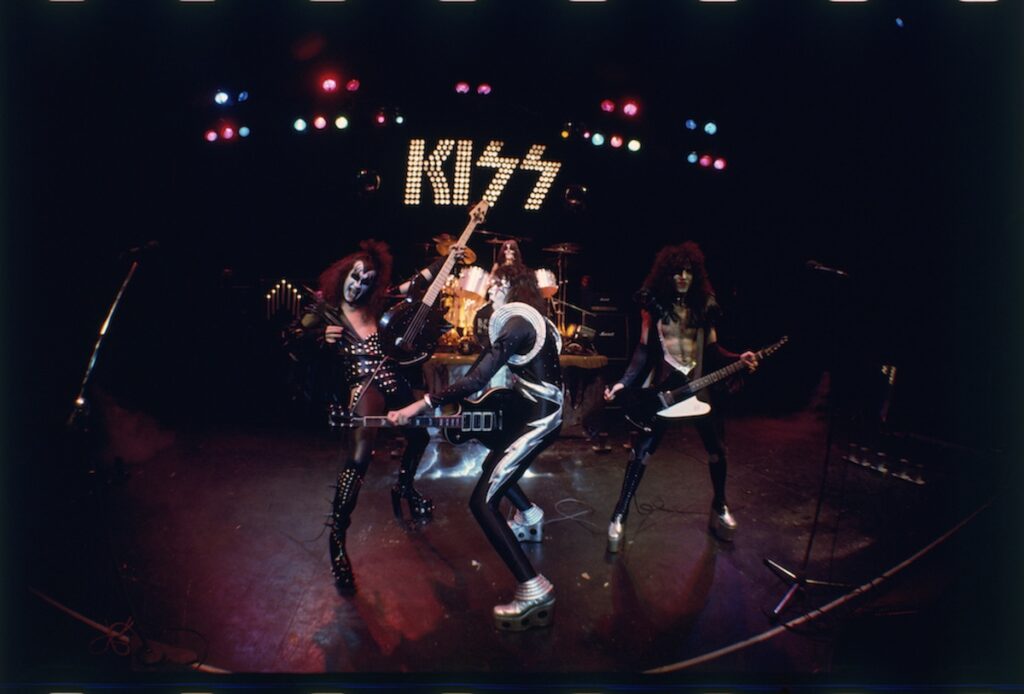
On September 10, 1975—exactly fifty years ago today—KISS released Alive!, the double-LP that transformed them from a cult curiosity into a mainstream phenomenon and redefined what a live rock album could be. Capturing the band’s pyrotechnic swagger in grooves at last, Alive! quickly became the group’s commercial breakthrough, peaking at No. 9 on the Billboard 200 and ultimately staying on the chart for an extraordinary 110 weeks, the longest run of any KISS release. That endurance—combined with a galvanizing new hit single in the live version of “Rock and Roll All Nite,” which climbed to No. 12 on the Hot 100—turned 1975–76 into the moment KISS “came alive” for the masses.
The recording itself was a movable feast. Producer Eddie Kramer recorded the band across multiple Rust Belt strongholds in the summer of 1975—Cobo Arena in Detroit (May 16), Cleveland Music Hall (June 21), Davenport’s RKO Orpheum (July 20), and the Wildwoods Convention Center in New Jersey (July 23)—then brought the tapes back to Electric Lady Studios in New York. There, facing the realities of an extremely athletic stage act (“much leaping about,” as Kramer put it), he and the band tightened performances with guitar and vocal touch-ups so the record would match the explosive memory fans carried out of the arena. The result still feels live—sweaty, communal, adrenalized—while hitting with the clarity and punch those early studio albums never quite achieved.
Alive! didn’t just rescue a band—it steadied a record label. Casablanca Records was in dire financial straits by mid-1975 after several costly misfires, and manager Bill Aucoin even fronted touring money to keep KISS on the road. The success of Alive! supplied the Top-10 album Casablanca desperately needed and helped put the label on a path toward its late-’70s boom. In that sense, the album’s metallic roar doubled as a bailout siren, proving that the band’s ferocious stagecraft could monetize where the first three studio LPs had stalled.
Part of the alchemy was presentation. Alive! opens with road manager J.R. Smalling’s now-iconic rallying cry—“You wanted the best, you got the best…”—which has introduced KISS shows ever since. That moment, followed by the concussive jolt of “Deuce,” framed the record as a portal: headphones became a fifth-row seat. The band’s signature sing-along, “Rock and Roll All Nite,” made the transition from underperforming studio single to generational anthem in this setting, and the track’s chart rebound as a live cut became the calling card for the whole project.
Critics in 1975–76 were not all impressed. Rolling Stone’s original review dismissed the music as “awful, criminally repetitive, thuddingly monotonous,” emblematic of a broader skepticism toward arena rock. But time has been kind to Alive!: modern appraisals routinely place it among the greatest live albums ever recorded, and AllMusic flatly calls it KISS’s finest record. The critical arc from scorn to canonization mirrors the way fans heard the album from day one—less as a document of flawless musicianship than as a vivid souvenir of communal spectacle and release.
Commercially, the milestones stack up. Beyond its Top-10 peak and two-year chart hang, the album delivered KISS’s first RIAA award—gold certification on December 4, 1975. Although the band and many historians contend that Alive! has sold in the multiple-millions worldwide, its U.S. certification history remains oddly under-updated, a quirk often noted by KISS chroniclers even as the album’s cultural footprint has only grown. What’s indisputable is that Alive! became the franchise cornerstone that powered the sequencing of Destroyer in 1976 and set up the band’s late-’70s imperial phase.
As KISS marks the 50th anniversary of Alive! today, the album endures because it bottles a sensation: the thud of Peter Criss’s kick, the serrated hook of Ace Frehley’s leads, Gene Simmons’s bass-growl bravado, and Paul Stanley’s ringleader charisma—punctuated by the roar of a crowd that believed. Half a century on, those opening words still flip a switch in the listener’s head, transporting you to a room of flash pots and confetti where, for 72 minutes, you really do get the hottest band in the land.
