

Cain and guitarist Neal Shon had a tumultuous relationship recently that has since been mended

UPDATED: Friday, October 10 at 3:25 PM EST
Journey keyboardist Jonathan Cain has reportedly left the band. According to a statement shared on X (formerly Twitter) by guitarist Neal Schon, Cain “announced his farewell” to the group on the evening of Thursday, October 9. In the post, Schon also confirmed the band’s plans for an upcoming tour, which is rumored to be their last. Cain has been labeling the to-be-announced trek as a farewell in recent interviews.
“Jonathan Cain announced his farewell to Journey tonight,” Schon said. “I’m nowhere near done! Journey has so much more life ahead! I’m sure we’ll have a great tour!”
In the comments, Schon confirmed that he and Cain are on good term, and Cain’s departure from Journey is purely so he can “do his ministry.”
On Friday, a spokesperson for Cain released a statement, clarifying Schon’s social media post.
“Jonathan Cain remains an active member of Journey, and any reports suggesting otherwise are inaccurate. He is fully dedicated to touring with the band over the next couple of years and has only expressed plans to retire at a later time.”
Recently, Journey shared a group photo on their official social media channels, asking fans in the caption what songs they want to hear on the bands upcoming “26-27” tour.
In a recent interview with Eddie Trunk on Trunk Nation last week, Schon gave fans an update on his relationship with Cain. At the time, he was happy with the state of his relationship with Cain and optimistic about touring together next year.
“Everything is cool. You know, we decided to take a year off, of which we did, [and that] gives everybody some time to think about everything that’s going on. You know, I’ve had some great conversations with Jonathan [Cain] lately and some great meetings with him for the first time in many years. We seem to be on the same page, which is a good sign for me. I think that it’s going to be a fun, happy tour. [It’s not going to be] just me standing on one side of the stage and Jon on the other… I really think we’re going to come together this time.”
Neal Schon founded Journey back in 1973. Jonathan Cain joined the group in 1980, and is currently – or reportedly, up until now – the band’s second-longest tenured member. Over the years, Schon and Cain have co-managed certain business operations tied to the band. One of the key corporate vehicles is Freedom 2020, Inc., an entity that handles touring and related business for Journey. The structure was such that Cain and Schon each owned 50% of the company and each served as the only directors, giving them equal control but also the potential for deadlock in decision-making.
Tensions mounted over what Cain alleged was mismanagement and excessive spending by Schon. In July 2024, Cain filed a lawsuit in Delaware’s Court of Chancery seeking relief against Schon and the corporate structure. The complaint included a series of accusations:
- Schon was allegedly using the company’s American Express credit card excessively, “maxing it out” (with a purported $1 million credit limit) and making expenditures beyond what’s reasonable for band business.
- Cain claimed Schon had spent up to $10,000 per night on hotel rooms (well beyond an internal $1,500 per-night hotel limit) for himself and his wife.
- Additional allegations included chartering private jets under the company’s financial umbrella, hiring extra security (reportedly personal or favor-driven), and interfering with the company’s ability to pay crew or meet obligations due to these elevated expenses.
- Cain also contended that Schon’s unilateral managerial actions and refusal to accept oversight risked impairing the company’s financial stability.
In Cain’s filing, he sought court intervention to restructure how deadlocks between the two could be resolved — specifically, the appointment of a neutral third party (or custodian) to break tie votes.
Schon, in turn, responded by denying the allegations. He claimed that Cain’s accusations were damaging, disruptive, and intended to harm Schon personally and to create a hostile working environment. His legal team asserted that there was no mismanagement, and that any dysfunction was a result of Cain’s own approach.
The band’s U.K. and Ireland tour dates were abruptly canceled amid the legal conflict, which observers saw as tied to the internal financial and managerial strife.
The dispute escalated fairly swiftly in court. Because the matter involved a deadlock between equal owners/directors in a Delaware corporation, the Court of Chancery was an appropriate forum.

On August 28, 2024, the court issued an order appointing Joseph R. Slights (a former vice chancellor) as a custodian(i.e. a deadlock-breaking neutral) to act as a third decision-maker for future disputes between Cain and Schon. Under the order:
- Schon is prohibited from unilaterally acting on behalf of Freedom 2020 in matters where a deadlock exists.
- In any future impasse between Cain and Schon as co-directors, the custodian has the authority to cast the deciding vote.
- The custodian may call, attend, and preside at meetings of the board, delegate authority, and retain advisors as needed, always acting in the company’s best interests.
Cain characterized the outcome as a legal victory, saying it aligned with the relief he had requested in his complaint. Schon did not formally oppose the appointment of the custodian, though subsequent filings revealed he attempted to limit the custodian’s role.
In short, the court did not order financial damages or declare wrongdoing in full. Instead, it restructured the corporate governance by inserting a neutral third-party decision-maker to prevent future stalemate and unilateral excesses.
With a formal mechanism in place to break deadlocks, Cain and Schon have signaled a desire to “move beyond this matter” and refocus on Journey’s music and touring plans. The appointment of Slights was viewed by Cain’s side as restoring a sense of balance and oversight to the business operations.
However, media coverage suggests that tensions remain. Schon had already publicly criticized Cain’s filing as harmful and accused him of fostering a hostile environment. And Cain’s team, in later court documents, accused Schon of attempts to limit the custodian’s powers, implying distrust even after the court order.
It’s too early to say whether the judicially imposed structure will fully stabilize the dynamic or if further conflict will reemerge. The custodian’s role may help mediate future disagreements, but success depends on whether both sides genuinely adhere to the governance framework.
From a public image perspective, the dispute has drawn attention to underlying friction within Journey’s leadership, potentially coloring fan and industry perceptions of internal discord. The cancellation of tour dates in the U.K./Ireland, although officially attributed to “circumstances beyond the band’s control,” was widely interpreted as tied to the dispute.
Because most details of their personal relationship remain private, much of what can be said is inferred from statements and actions. The fact that the conflict spilled into public lawsuits suggests a breakdown of prior trust or informal resolution channels. Schon’s strong statements about slander and disruption indicate that he felt personally attacked and sought to defend his reputation vigorously. In contrast, Cain viewed court intervention as necessary to enforce financial accountability and governance restraint.
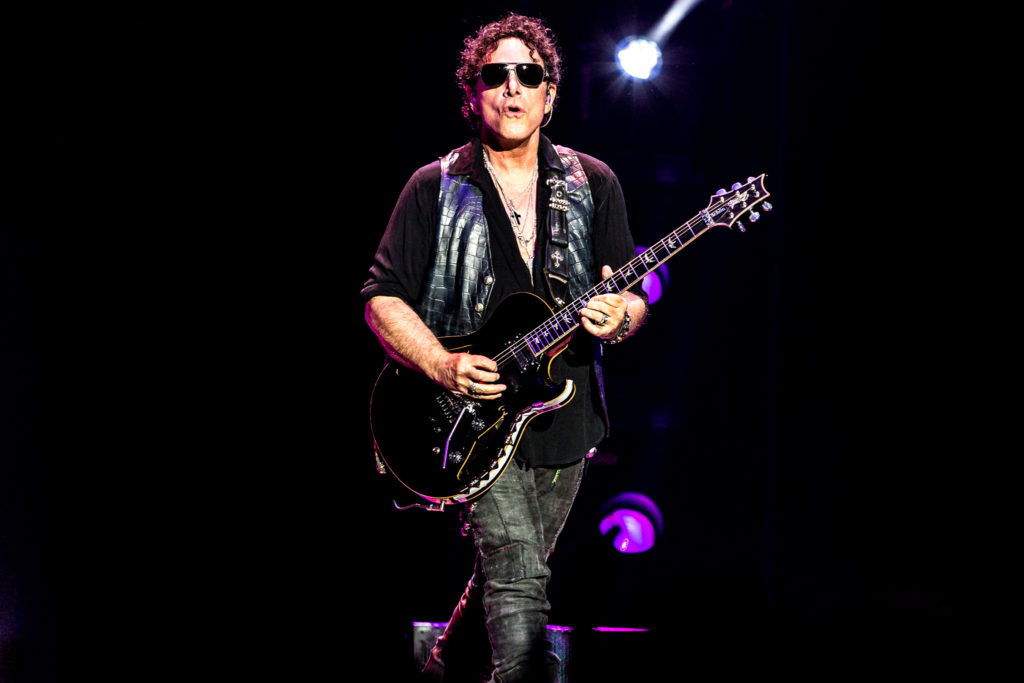
Even after the court’s order, there have been hints of ongoing friction: litigation filings pointing to disagreements over implementation, the custodian’s authority, and how strictly each party should be bound. Yet both sides have expressed a commitment to carry on with the tour and band operations, suggesting at least a pragmatic willingness to operate together under the new guardrails.
One could imagine that, even if musical collaboration continues, the personal relationship will retain wariness. Whether tensions gradually cool or flare anew likely depends on future conflicts and whether the custodian mechanism is respected.
This kind of dispute is not uncommon in bands or creative partnerships where artistic collaboration intertwines with business ownership. Equal ownership without a tie-breaker can lead to paralysis or unilateral excess. In that sense, the Delaware Chancery Court’s solution is relatively standard: impose a neutral director or custodian to break deadlocks. It offers a way to preserve continuity (i.e., the band continues touring) while preventing any one party from dominating.
However, legal resolution does not guarantee interpersonal reconciliation. The best outcome long-term is that both Cain and Schon acknowledge structural controls and allow the custodian to operate with integrity.
Journey had a stacked schedule in 2024. Before their summer stadium run with Def Leppard, the band is hit the road on a new leg of their ongoing 50th anniversary tour with very special guests Toto. The 30-show trek began on February 9 at the Mississippi Coast Coliseum in Biloxi, Mississippi and wrapped up on April 29 at the Total Mortgage Arena in Bridgeport, Connecticut. Very special guests for the trek were once again Toto.
In July of 2022, Journey released Freedom (BMG/Frontiers) – their first studio album in over a decade. The follow-up to 2011’s Eclipse, it marks the longest gap between albums in the band’s career. The all-new Freedom is also the band’s most hefty release, with 15 songs that clock in over an hour. Produced by guitarist Neal Shon and keyboardist Jonathan Cain, alongside Narada Michael Walden (Elton John, Santana, Steve Winwood). Anchored by the lead single, “The Way We Used to Be,” the album produced four more singles and landed at No. 17 on Billboard’s Top Rock Albums chart.