

The legendary musician succumbed to lung issues after beating cancer

The Grateful Dead guitarist and co-founder Bob Weir has died. The legendary musician “succumbed to underlying lung issues” after “courageously beating cancer,” according to a statement from his family. He was 78-years old.
“It is with profound sadness that we share the passing of Bobby Weir. He transitioned peacefully, surrounded by loved ones, after courageously beating cancer as only Bobby could. Unfortunately, he succumbed to underlying lung issues.
For over sixty years, Bobby took to the road. A guitarist, vocalist, storyteller, and founding member of the Grateful Dead. Bobby will forever be a guiding force whose unique artistry reshaped American music. His work did more than fill rooms with music; it was warm sunlight that filled the soul, building a community, a language, and a feeling of family that generations of fans carry with them. Every chord he played, every word he sang was an integral part of the stories he wove. There was an invitation: to feel, to question, to wander, and to belong.
Bobby’s final months reflected the same spirit that defined his life. Diagnosed in July, he began treatment only weeks before returning to his hometown stage for a three-night celebration of 60 years of music at Golden Gate Park. Those performances, emotional, soulful, and full of light, were not farewells, but gifts. Another act of resilience. An artist choosing, even then, to keep going by his own design. As we remember Bobby, it’s hard not to feel the echo of the way he lived. A man driftin’ and dreamin’, never worrying if the road would lead him home. A child of countless trees. A child of boundless seas.
There is no final curtain here, not really. Only the sense of someone setting off again. He often spoke of a three-hundred-year legacy, determined to ensure the songbook would endure long after him. May that dream live on through future generations of Dead Heads. And so we send him off the way he sent so many of us on our way: with a farewell that isn’t an ending, but a blessing. A reward for a life worth livin’.
His loving family, Natascha, Monet, and Chloe, request privacy during this difficult time and offer their gratitude for the outpouring of love, support, and remembrance. May we honor him not only in sorrow, but in how bravely we continue with open hearts, steady steps, and the music leading us home. Hang it up and see what tomorrow brings.”

Bob Weir stands as one of the most enduring and quietly influential figures in American rock history, a rhythm guitarist and songwriter whose career has stretched across more than six decades while helping to define the sound, culture, and philosophy of the Grateful Dead. Born October 16, 1947, in San Francisco and adopted as an infant, Weir was raised in the Bay Area and met future Dead co-founder Jerry Garcia on New Year’s Eve 1963 while hitchhiking in Palo Alto. The two bonded instantly over folk and blues music, soon forming the nucleus of what became the Warlocks and, by 1965, the Grateful Dead. As the group evolved into the house band for Ken Kesey’s Acid Tests and the epicenter of the psychedelic counterculture, Weir developed a highly unorthodox approach to rhythm guitar—favoring jazz-like chord voicings, syncopated patterns, and contrapuntal interplay rather than traditional strumming. His singing voice and songwriting perspective also gave the Dead a crucial balance to Garcia’s lead style, with Weir penning or co-writing many of the band’s most enduring songs, including “Sugar Magnolia,” “Playing in the Band,” “Cassidy,” “The Music Never Stopped,” “Estimated Prophet,” “Looks Like Rain,” and “Throwing Stones.” By the 1970s, he was a defining presence in the group’s legendary live improvisations, often steering jams into adventurous, polyrhythmic territory.
While the Grateful Dead remained his primary musical home through the band’s dissolution following Garcia’s death in 1995, Weir also built a substantial solo career that reflected his eclectic tastes. His first solo album, Ace (1972), is widely considered one of the finest Dead-adjacent records, featuring contributions from the entire Grateful Dead lineup and yielding concert staples such as “Playing in the Band.” He followed it with Heaven Help the Fool (1978), Blue Mountain (2016), and several collaborative projects, often exploring country, folk, and Americana textures that complemented his Dead work. In the mid-1970s he co-founded the side project Kingfish, achieving radio success with “Lazy Lightning,” and later fronted Bob Weir & RatDog, a touring outfit active from the late 1990s through 2014 that blended Dead material with blues, jazz, and original compositions. RatDog kept the improvisational spirit alive while allowing Weir to refine his identity as a bandleader, extending the Dead’s musical legacy into a new era.
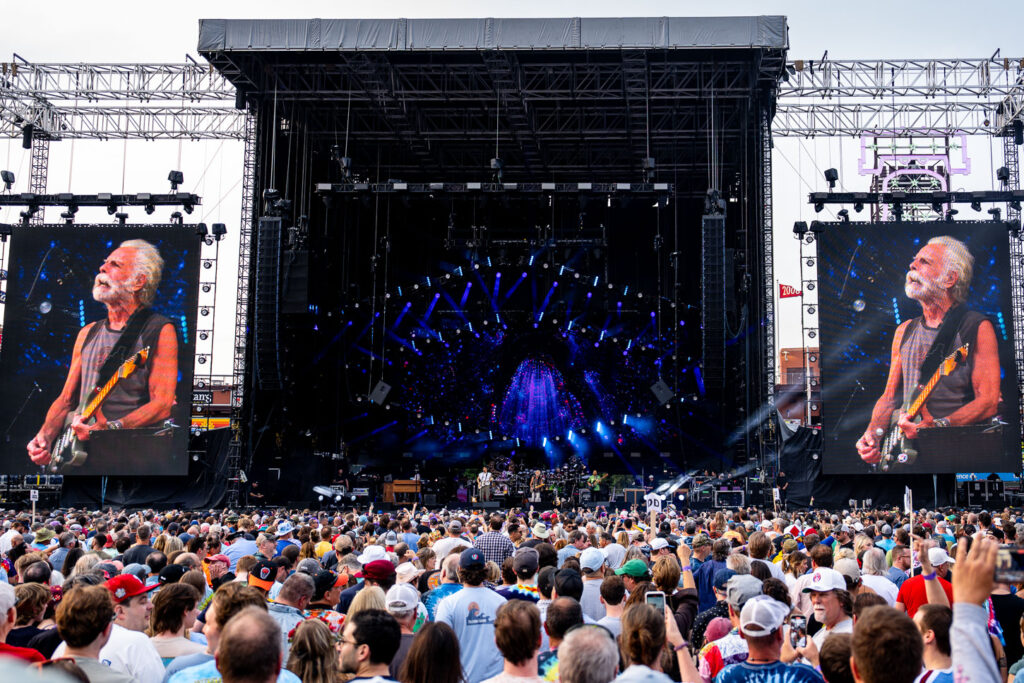
In 2015, Bob Weir helped usher the Grateful Dead’s music into a new generation as a founding member of Dead & Company, alongside fellow original members Mickey Hart and Bill Kreutzmann and a younger lineup that included John Mayer on lead guitar, Oteil Burbridge on bass, and Jeff Chimenti on keyboards. What began as a celebratory project quickly became a major touring phenomenon, selling out amphitheaters and stadiums across North America while introducing the Dead’s songbook to millions of new fans. Weir’s presence provided both historical continuity and musical authority, his intricate rhythm style anchoring the band’s expansive jams while his vocals lent emotional weight to classics like “Sugar Magnolia,” “Jack Straw,” and “The Other One.” Through Dead & Company’s final tours in the early 2020s, Weir once again proved that the Grateful Dead’s music was not a relic of the past but a living, evolving tradition.
Revisit our review and live photos from Dead and Company’s final show in Philadelphia back in 2023 HERE.
Across his career, Bob Weir has embodied the idea that rock music can be both communal and exploratory, rooted in tradition yet endlessly open to reinterpretation. From the acid-soaked ballrooms of San Francisco in the 1960s to stadium stages in the 21st century, his songwriting, guitar work, and restless creativity have made him a central architect of the Grateful Dead’s enduring legacy—one that continues to resonate long after the band’s original era has passed.