

The man behind the riffs and pinch-harmonic squeals of “Mother,” “Twist of Cain” and “How the Gods Kill” passed away peacefully after a months-long health struggle
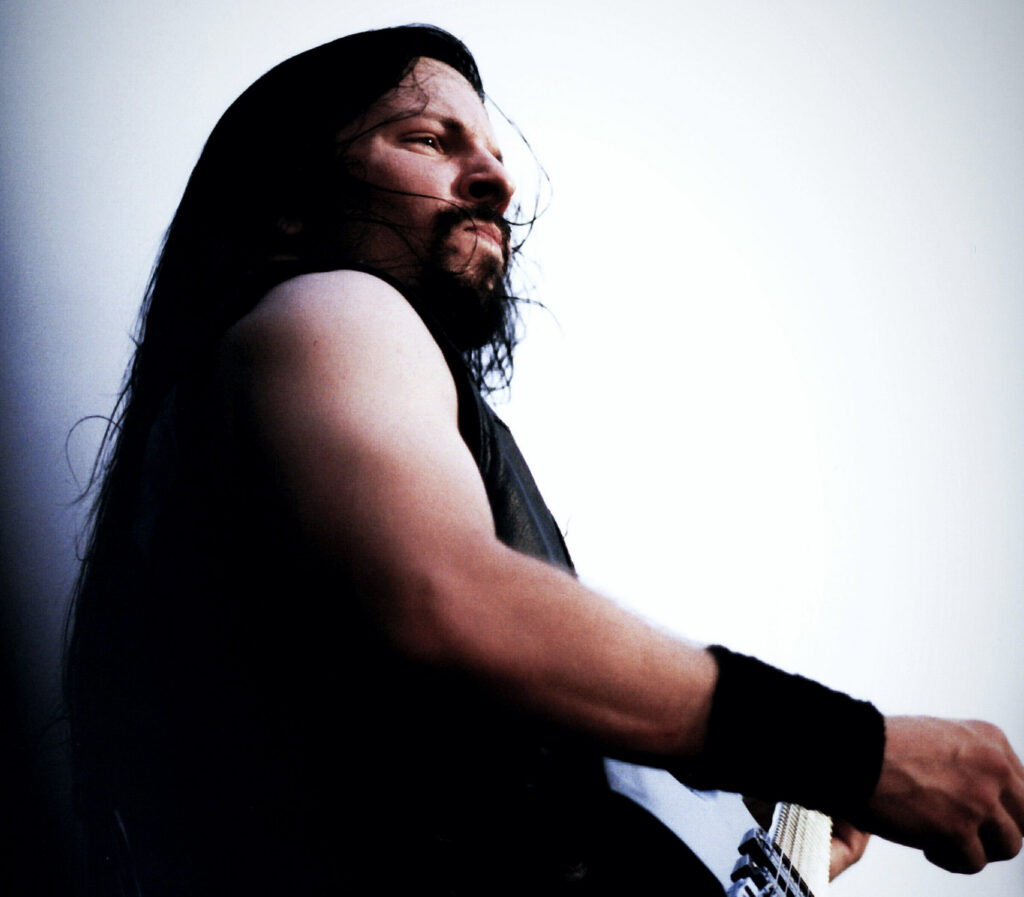
John Christ, the original guitarist of Danzig and the player whose bluesy, snarling leads defined the band’s first four albums, has died. He was 61.
His death was announced on Monday, November 16, through his official social media accounts. The family’s statement, posted alongside a simple black memorial image, said Christ passed away peacefully on Sunday, November 15, 2026. It added that no services are planned, asked fans to respect the family’s privacy, and closed with a line that will resonate with anyone who ever met him at a show or convention: “John loved each and every one of you.”
The family has not disclosed a cause of death. However, Christ had been open with fans that something was wrong. This past September, he announced he was postponing his live performances and pausing the guitar lessons he gave, so he could focus on what he called “a medical issue that has been kicking my butt.” He thanked supporters for their patience and said he intended to get back to playing once his health allowed. Reports at the time indicated doctors had advised him to take several months away from the stage. His Instagram account then went quiet until the announcement of his death.
Ghost Cult Magazine has reported that Christ died after a brief battle with cancer. That detail has not been confirmed by the family’s statement or by other major outlets, which have stated that no official cause of death has been revealed. As of this writing, no public statements from Glenn Danzig or from Christ’s classic-lineup bandmates Eerie Von and Chuck Biscuits had been reported.
A Maryland kid with classical training
John Christ was born John Wolfgang Knoll on February 19, 1965, in Baltimore, Maryland. The youngest of five children and the only boy among four older sisters, he grew up in Catonsville, Maryland, and attended Catonsville High School.
Music came early. He took piano lessons before picking up an acoustic guitar in grade school, then switched to electric at 13, starting on a Univox Les Paul copy. He later recalled that his sisters air-guitaring to Aerosmith in the family kitchen in the late ’70s helped light the fuse. Ted Nugent was his first guitar hero, and Nugent and ZZ Top’s Billy Gibbons were the source of the pinch harmonics that would become his signature.
Unlike many of his hard rock peers, Christ was formally trained. He studied classical guitar at Baltimore’s Peabody Institute, then moved on to Towson University, where he studied jazz, theory and composition, including under jazz educator Hank Levy. That mix of blues feel, rock aggression and conservatory discipline would make him an unusually versatile foil for Glenn Danzig.
Bleeding for Samhain
In 1986, a friend told Christ that Samhain, Glenn Danzig’s post-Misfits band, was looking for a guitarist. He initially passed, but changed his mind once the band was lined up for a deal with producer Rick Rubin. He auditioned through drummer London May, with whom he would later share an apartment in New Jersey.
The audition has become part of Danzig lore. Christ tore a fingernail while playing, bled onto his guitar, and left bloody marks on Glenn Danzig’s shoulder. Rubin liked what he heard. Christ auditioned a second time and, according to the often-told story, sealed the deal by leaving guitar solos on Danzig’s answering machine. He was accepted as the band’s permanent guitarist on February 2, 1987, dropped out of college, and moved to New Jersey. His work from those sessions appears on Samhain’s Final Descent.
At first he performed as “John Von Christ,” a name he and drummer Chuck Biscuits came up with while sharing an apartment. It was shortened to avoid clashing with bassist Eerie Von. Before long, Rubin’s plan to retool Samhain into something bigger took shape, and the band became Danzig.
The classic Danzig years (1987–1995)
With Glenn Danzig on vocals, Eerie Von on bass and Chuck Biscuits on drums, Christ was part of what many fans still consider the definitive Danzig lineup. He played on every Danzig release from the 1988 debut through Danzig 4:
- Danzig (1988)
- Danzig II: Lucifuge (1990)
- Danzig III: How the Gods Kill (1992)
- Thrall-Demonsweatlive EP (1993)
- Danzig 4 (1994)
His playing also turns up on later archival releases, including Live on the Black Hand Side (2001) and The Lost Tracks of Danzig (2007), and on the 1987 Less Than Zero soundtrack track “You and Me (Less Than Zero)” with Glenn Danzig & the Power and Fury Orchestra.
Christ’s sound was built around a 1983 BC Rich Bich he nicknamed “The Bitch” (a customized 10-string backup now hangs at the Hard Rock Cafe in Orlando), heavy doses of blues phrasing, and those piercing pinch harmonics. He counted “Mother” among his favorite songs, crediting Nugent’s influence on its solo. The song became a belated hit in 1994, when the live version from Thrall-Demonsweatlive caught fire on MTV, and it remains Danzig’s best-known track.
His personal favorite album was How the Gods Kill, where engineer Nick DiDia helped him capture a broad range of tones. For the title track, he rented one of Jeff Beck’s old Stratocasters. Guitar World later ranked him No. 63 on its list of the 100 greatest metal guitarists.
Leaving Danzig
Christ officially left Danzig on July 5, 1995, citing a breakdown in communication within the band. Biscuits had departed in 1994, and Von left in 1995 as well, ending the classic lineup. Glenn Danzig moved in a more industrial direction on 1996’s Blackacidevil.
In later interviews, Christ was candid about the split. Speaking to Guitar World in 2023, he said he, Von and Biscuits had been stuck in difficult contract negotiations and felt they were being squeezed out, with Glenn Danzig enjoying the backing of the label and management while the rest of the band had no one in their corner. In a 2024 interview with Vanyaland, he said he had been kept unaware of the legal and financial issues at the time and afterward felt blacklisted.
He could also be generous about it. He praised Tommy Victor, who took over guitar duties, for playing the songs his own way rather than copying him, and he wondered aloud whether better communication on his part might have kept the original band together longer. He told Metal Insider that the original lineup’s years together were a magical time. Despite years of reunion speculation, Christ said Glenn Danzig never called him about one.
Life after Danzig
Christ had big ambitions after leaving. He admitted he wanted Kirk Hammett’s spot in Metallica “so badly that I could taste it,” and would also have welcomed a gig with Ozzy Osbourne. Instead, in 1997 he joined the short-lived Juice 13, which featured former Ozzy drummer Randy Castillo.
After several years of stops and starts, he released his first and only solo album, Flesh Caffeine, in 1999. Recorded in a home studio in his Southern California condo, it included riffs he had originally written for Danzig that Glenn had passed on. Christ later called that stretch one of the best periods of his life.
He stayed busy in other corners of the business too. His guitar work was used by ABC and Australia’s Nine Network, where he backed performances by Tom Jones and Lou Rawls. He contributed to compilations including Guitar’s Practicing Musicians Vol. 3 (“For Christ’s Sake,” recorded with Chuck Biscuits), Guitars That Rule the World, Vol. 2 and Mike Hartman’s Black Glue. On 2001’s Metallic Assault: A Tribute to Metallica, he played on a darker take on “Enter Sandman” alongside Robert Trujillo, Burton C. Bell and Tommy Aldridge. Years later, he added guitar to “Revival Mode” on Every Time I Die’s 2012 album Ex Lives.
Disillusioned with the music industry, Christ also stepped away for a time and went into the business of supplying trucks to film and television sets.
The accident and the long road back
In 2004 (some sources say 2003), Christ was nearly killed. By his own account, he was driving a garbage truck with a 30-foot bed on a California freeway when a front tire blew out. The truck struck a Jersey barrier and rolled, throwing him into oncoming traffic.
The injuries were devastating for anyone, and especially for a guitarist: punctured lungs, broken ribs, a skull fracture and a crushed fretting hand. He needed surgeries and speech therapy, and had to relearn how to walk. It was more than a year before he could hold a guitar. Some fingertips on his left hand never regained feeling, and he said he still had nightmares about the crash.
He rebuilt his playing largely by ear and repetition. On November 27, 2009, he returned to the stage for the first time in roughly a decade with a solo performance in Essex, Maryland, a show in which he moved easily between Danzig material, Stevie Ray Vaughan and even “The Wizard of Oz.” In later years he described himself as sober, and said his approach to the guitar had changed: less about pushing the instrument to its limits, more about listening to it.
Final years
Back home in Maryland, Christ taught guitar at a college and continued to give lessons. He played his own solo material and became a regular guest at horror and comic conventions, where he was struck by how much the early Danzig records still meant to fans. At his first convention appearance, he reunited with Eerie Von. In 2024 he brought “Confessions of Christ,” a storytelling-and-performance show about his life in music, to the Shadows of Salem Horror & Paranormal Con in Massachusetts.
One regret stayed with him: in 2010, Misfits co-founder Jerry Only had offered him an opportunity he didn’t pursue, which he attributed to going through a divorce at the time.
He was still teaching and playing live until this September, when illness forced him off the stage.
Legacy
Glenn Danzig wrote the songs and owned the voice, but for many fans it was John Christ’s guitar that gave the early Danzig records their swing and menace: the squealing harmonics, the bluesy bends, the way a song like “Mother” or “Twist of Cain” sounded both heavy and loose. The classic lineup’s chemistry has rarely been matched, and Christ himself said that later versions of those songs never had the same “caged animals” energy.
He survived a falling-out with one of metal’s most formidable personalities and an accident that should have ended his career, and he spent his last years teaching, playing and swapping stories with the fans who never forgot him. John Christ was 61.