

The shock rock icon mounted one of his most successful tours to support the record
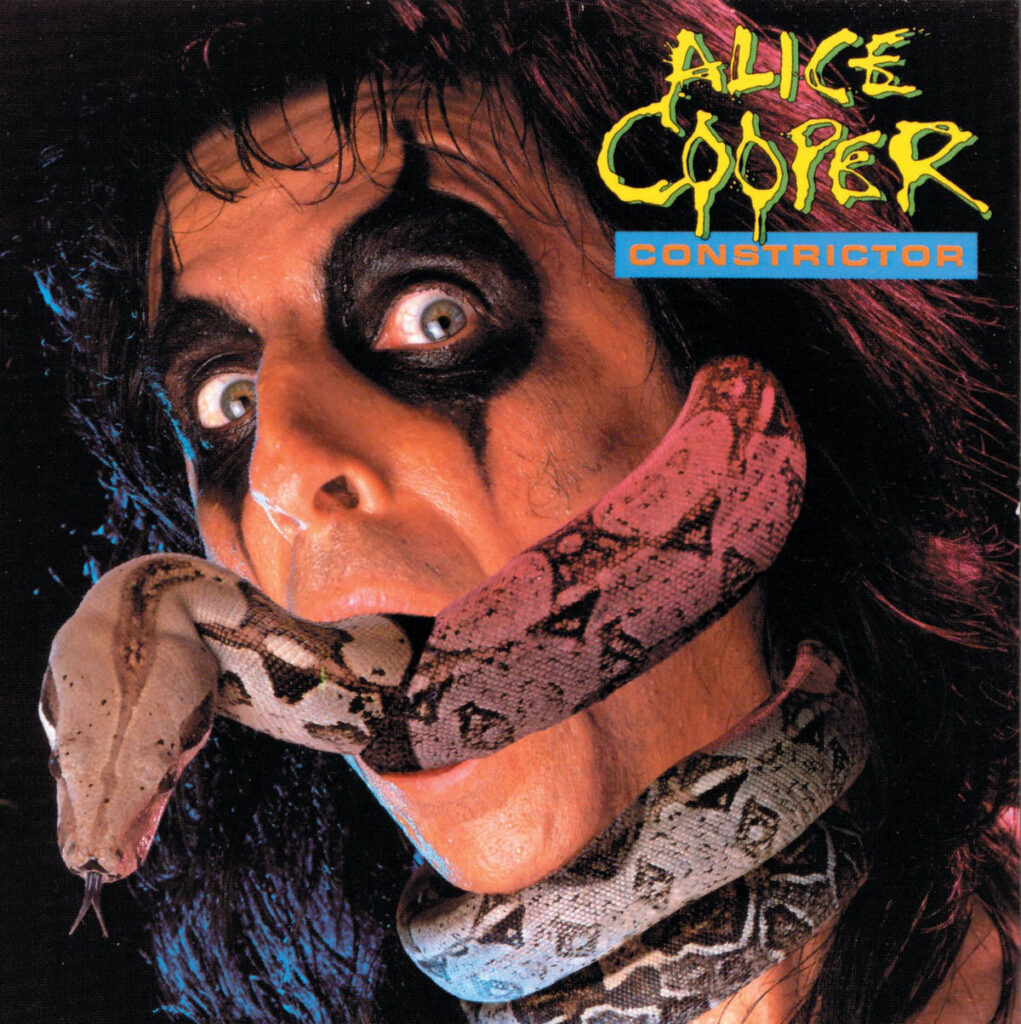
On this day 40 years ago, Alice Cooper came roaring back with his ninth solo album Constrictor.
The release was much more than another studio album—it marked the beginning of one of rock’s great career resurrections. Cooper had largely disappeared from the music business following 1983’s DaDa, stepping away during a period in which substance abuse and declining commercial fortunes had taken a heavy toll. By the middle of the decade, however, he was sober, energized and ready to reintroduce the Alice Cooper character to a generation dominated by heavy metal and glam metal bands that owed a considerable debt to his theatrical style. A major catalyst was guitarist Kane Roberts, whom Cooper met in 1985 and quickly began writing with.
The two bonded over loud rock music, horror movies and a similar sense of humor, while Roberts helped Cooper embrace the polished, muscular metal sound dominating the mid-1980s. Producer Beau Hill, known for his work with Ratt, was brought in because Cooper admired the sound Hill had achieved with that band, while Michael Wagener contributed production and mixing work. Recorded with a lineup that included Roberts, bassist Kip Winger and drummer David Rosenberg, Constrictor combined Cooper’s familiar macabre humor with huge guitars, synthesizers and an unmistakably contemporary ’80s production style.
The resulting record sounded deliberately different from Cooper’s experimental early-’80s albums. Songs such as “Teenage Frankenstein,” “Give It Up,” “Simple Disobedience,” “The World Needs Guts” and “The Great American Success Story” presented a louder and more straightforward hard-rock version of Cooper, with Roberts supplying much of the album’s flashy guitar attack. Its best-known song, “He’s Back (The Man Behind the Mask),” became tied to Friday the 13th Part VI: Jason Lives and gave Cooper a natural connection to the horror audience that had always complemented his stage persona; “Teenage Frankenstein” was also heard in the film.
Contemporary reaction was generally encouraging, particularly given how far Cooper’s commercial profile had fallen. Billboard characterized the album as a refreshing return with a harder edge, while Kerrang! gave it an enthusiastic review and praised it as Cooper’s strongest album in years. Retrospective assessments have been somewhat more mixed: AllMusic considers Constrictor lively and important to Cooper’s re-establishment while also criticizing it for containing too much filler. Fans, meanwhile, embraced songs such as “Teenage Frankenstein” and the horror-themed “He’s Back,” and the subsequent Nightmare Returns tour restored the elaborate executions, monsters, snakes and theatrical spectacle that had made Cooper one of rock’s most distinctive live performers.
Commercially, Constrictor was not a return to the blockbuster numbers Cooper had enjoyed during the 1970s, but it accomplished something arguably more important: it put him back in the marketplace. The album reached No. 59 on the Billboard 200, a significant improvement after Zipper Catches Skin and DaDa had failed to reach the chart, while “He’s Back (The Man Behind the Mask)” found particular success in Europe. More importantly, the record established the foundation for Cooper’s late-’80s comeback, leading directly into 1987’s similarly metal-oriented Raise Your Fist and Yelland ultimately the major commercial revival of 1989’s Trash and its hit “Poison.” Forty years after its release, Constrictoris therefore best understood as a transitional but crucial Alice Cooper album. It was not an attempt to recreate Killer, School’s Out or Welcome to My Nightmare; instead, Cooper adapted his character to the MTV and glam-metal era at a moment when many of the decade’s biggest bands were borrowing ideas he had pioneered years earlier.
The production unmistakably dates the record to 1986, but that is also part of its identity. Constrictor proved that Alice Cooper could survive changing musical fashions, reclaim his theatrical persona and begin rebuilding a career that has endured for decades—making its lasting legacy less about sales or chart peaks than the fact that it was the album that successfully put Alice back behind the mask.