

The rock legend pulled out of the band’s current tour just days ago due to undisclosed health issues
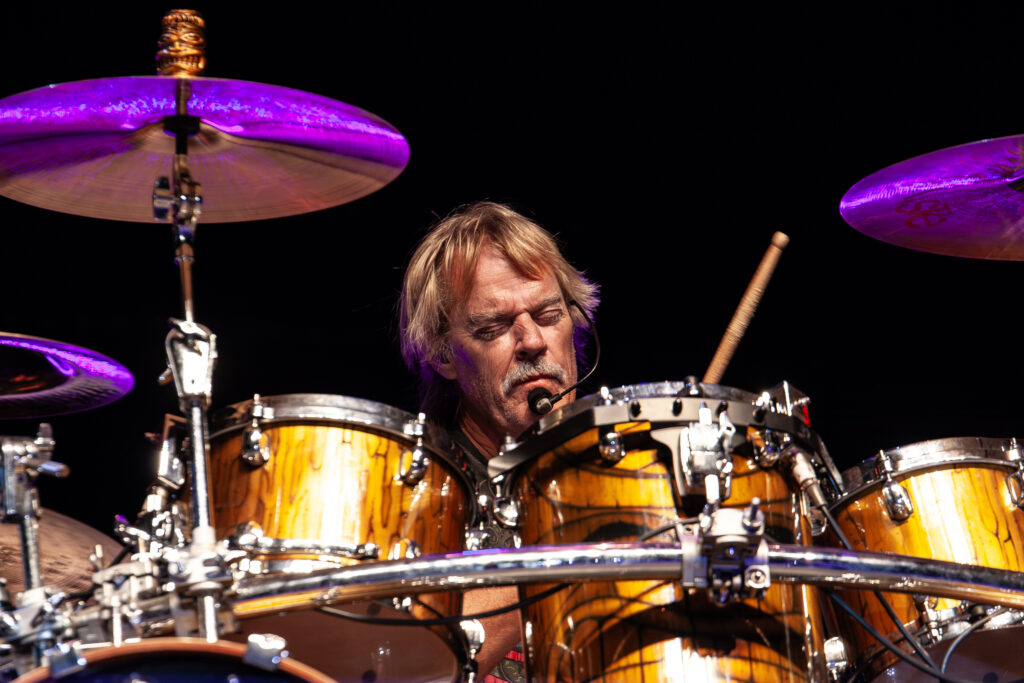
Frank Beard, legendary drummer for rock icons ZZ Top, has died. Beard performed with the Texas trio for over five decades. He was 77-years old.
“Today, Elwood and I lost a great friend and collaborator, and the world lost one of the most naturally innovative drummers and a great and true son of Texas,” ZZ Top guitarist and singer Billy Gibbons said in a statement. “His signature backbeat was key to keeping ZZ on top. The band of which he was part for six decades is going to keep on keeping on as he had wished.”
According to a report from the Fort Bend County Medical Examiner, Frank Beard passed away yesterday, August 17, at his Texas ranch after a brief stay in hospice. He was reportedly surrounded by family.
A cause of death was not immediately made available.
Given the circumstances, ZZ Top has canceled their scheduled concerts tonight (August 18) in Salt Lake City and tomorrow (August 19) in Colorado Springs. Per Frank’s final wishes, the tour will resume this weekend. The band will play two shows at Austin City Limits – one of Frank’s favorite venues.
On August 11, it was reported that Beard had pulled out of the band’s current tour due to undisclosed health issues. According to TMZ, sources with direct knowledge of the situation said Beard’s health was behind ZZ Top’s abrupt cancellation of its August 5, 2026 concert at the Hollywood Bowl in Los Angeles. At the time, the band did not disclose Beard’s condition, instead announcing that the show had been canceled because of unforeseen personnel issues. Guitarist and frontman Billy Gibbons described the circumstances as “insurmountable obstacles” and asked fans to remain patient with the band during what he characterized as a brief interruption. The exact nature and severity of Beard’s current medical problems have not been publicly disclosed.
The cancellation immediately raised questions about the band’s status because ZZ Top had been in the midst of its extensive 2026 touring schedule. The Hollywood Bowl appearance was supposed to feature ZZ Top alongside Cheap Trick, but the show was called off only hours before it was scheduled to take place. Cheap Trick subsequently arranged its own last-minute performance at the Troubadour in West Hollywood. ZZ Top eventually returned to the stage, but without Beard. When the group performed at the Mountain Winery in Saratoga, California, on August 8, Michael Monahan filled in on drums while Gibbons and bassist Elwood Francis carried on with the show. TMZ noted that Beard’s longtime substitute John Douglas has previously stepped behind the kit when Beard has been unavailable, but Monahan has been handling drums during Beard’s latest absence.
Rolling Stone subsequently reported that Beard has temporarily stepped away from ZZ Top’s current “The Big One” tour so he can focus on his health. A representative for the band indicated that Gibbons and Francis intend to continue touring with a substitute drummer while Beard addresses the undisclosed medical issue. That means the Hollywood Bowl cancellation does not currently appear to signal the suspension of the entire tour. Following the Saratoga performance without Beard, ZZ Top’s next scheduled appearance was set for August 11 in Redmond, Washington, with additional dates planned across the United States into October and concerts in Mexico and South America scheduled for November.
The latest development is particularly concerning because it follows multiple health-related absences for Beard during 2025. In March of that year, ZZ Top announced that the drummer was temporarily leaving the band’s Elevation Tour to address a health issue requiring his attention. Longtime drum technician John Douglas substituted for him during that period. Beard eventually returned to the road, with the band later revealing that he had been dealing with foot and ankle problems. He subsequently required another absence later in 2025 before again returning to the touring lineup. Those earlier medical issues were ultimately presented as temporary setbacks, but the current situation has attracted greater attention because TMZ’s sources characterized Beard’s latest health problems as serious and linked them directly to the high-profile Hollywood Bowl cancellation.
Frank Beard had been the band’s drummer since 1969 and, along with Billy Gibbons, represents one of the last remaining links to the classic lineup that made ZZ Top one of America’s most successful blues-rock bands. Beard, Gibbons and bassist Dusty Hill remained together for more than five decades, creating albums such as Tres Hombres, Fandango!, Degüello, Eliminator and Afterburner and recording enduring songs including “La Grange,” “Tush,” “Gimme All Your Lovin’,” “Sharp Dressed Man” and “Legs.” Following Hill’s death in 2021, longtime guitar technician Elwood Francis assumed bass duties at Hill’s request, allowing the group to continue touring.
Frank Beard, the longtime drummer whose powerful, deceptively economical grooves helped define the sound of ZZ Top for more than half a century, was one of the essential architects of Texas blues rock. Born Frank Lee Beard on June 11, 1949, in Frankston, Texas, and raised in Irving, Beard developed as a musician amid the fertile Texas blues and rock scene of the 1960s. Before achieving fame, he played in several groups, including the Cellar Dwellers, the Hustlers, the Warlocks and American Blues. It was during those formative years that Beard established a musical partnership with bassist Dusty Hill, with whom he would ultimately form one of rock music’s most durable rhythm sections. Beard and Hill even spent time playing as a rhythm section behind legendary Texas bluesman Lightnin’ Hopkins, an experience Beard later described as life-changing.
Beard’s career changed permanently in 1969 when he joined guitarist and singer Billy Gibbons in the developing lineup of ZZ Top. Gibbons had initially formed the group with different musicians, but Beard soon came aboard and recommended his former bandmate Hill when the group needed a bassist. With Gibbons on guitar, Hill on bass and Beard on drums, the classic ZZ Top lineup was complete. The trio released ZZ Top’s First Album in 1971, beginning a recording and touring partnership that would remain intact for roughly five decades. On some of the band’s earliest records Beard was humorously credited as “Rube Beard,” but he eventually returned to using his real name professionally. While Gibbons’ guitar tone and the group’s Texas imagery attracted much of the attention, Beard and Hill supplied the disciplined rhythmic foundation that allowed ZZ Top’s music to swing, shuffle and groove without becoming cluttered.
After the band’s 1972 album Rio Grande Mud expanded its audience, ZZ Top broke through nationally with 1973’s Tres Hombres. Featuring “La Grange,” the album established the band’s distinctive mixture of electric blues, boogie and hard rock and became its first Top 10 album. Beard’s drumming was crucial to that formula. Rather than relying on flashy solos or excessive fills, he specialized in deep-pocket playing that gave Gibbons room to stretch out while locking tightly with Hill. That approach was equally important on 1975’s Fandango!, which produced “Tush,” ZZ Top’s first Top 40 single. As the band became a major concert attraction during the mid-1970s, Beard supplied the muscular backbeat behind increasingly elaborate productions, culminating in the massive Worldwide Texas Tour of 1976 and 1977.
Success also brought serious personal problems. By the late 1970s, Beard was struggling with drug addiction, and during ZZ Top’s extended break following the Worldwide Texas Tour he entered rehabilitation. Years later, Beard openly discussed that period, while Gibbons made clear that replacing him permanently was never seriously considered. After Beard recovered, the trio returned with Degüello in 1979, an album that revitalized the band through songs such as “Cheap Sunglasses,” “I’m Bad, I’m Nationwide” and “I Thank You.” The period also produced one of rock’s great visual jokes: during the band’s hiatus, Gibbons and Hill independently grew the enormous beards that became their trademarks, while Beard—the member actually named Beard—continued to wear only a mustache.
ZZ Top underwent an even more dramatic transformation during the early 1980s. El Loco in 1981 began incorporating synthesizers and new-wave textures, but 1983’s Eliminator turned the group into international superstars. Songs including “Gimme All Your Lovin’,” “Sharp Dressed Man” and “Legs” combined Gibbons’ blues-based guitar with sequencers, synthesizers and a streamlined rhythmic pulse perfectly suited to both rock radio and MTV. Beard’s role became more controlled and precise as the band’s production grew increasingly technology-driven, yet the fundamental sense of swing remained rooted in the rhythm section he and Hill had developed years earlier. The hugely successful videos accompanying the album introduced ZZ Top to an entirely new generation and transformed three veteran Texas blues-rock musicians into unlikely icons of the MTV era.
The group continued the electronic approach on 1985’s Afterburner before gradually moving back toward a heavier blues-rock sound. Through albums including Recycler, Antenna, Rhythmeen, XXX and Mescalero, Beard remained the steady center of the group. ZZ Top’s commercial peak had passed by the 1990s, but its reputation as a touring band remained formidable. The trio’s longevity became nearly as famous as its music: while countless major rock bands endured lineup changes, breakups and reunions, Gibbons, Hill and Beard remained together continuously for more than 50 years. Their contribution to American music was formally recognized when ZZ Top was inducted into the Rock and Roll Hall of Fame in 2004.
Beard’s drumming was particularly well suited to ZZ Top because of what he chose not to play. His performances emphasized feel, timing and groove rather than technical exhibitionism. Tracks such as “La Grange,” “Tush,” “Cheap Sunglasses,” “I’m Bad, I’m Nationwide,” “Gimme All Your Lovin'” and “Sharp Dressed Man” demonstrate his ability to establish a forceful pulse while leaving space for the guitar and bass. AllMusic described the essence of ZZ Top’s sound as Gibbons’ guitar married to the simple but funky groove created by Hill and Beard. That restraint helped give the band its instantly recognizable swagger: even when its production changed dramatically from raw 1970s blues rock to polished 1980s pop-rock and back again, the rhythmic personality remained unmistakably ZZ Top.
The original trio’s extraordinary run finally ended with Dusty Hill’s death in July 2021 at age 72. At Hill’s request, longtime ZZ Top guitar technician Elwood Francis stepped into the bass role, and Beard and Gibbons chose to continue the band. The original trio’s final studio album was La Futura in 2012, although Gibbons, Hill and Beard later recorded stripped-down performances for the documentary ZZ Top: That Little Ol’ Band from Texas. Those sessions were subsequently released as the 2022 album RAW, providing another document of the chemistry that had sustained the three musicians for decades.
In his later years, Beard experienced health problems that increasingly affected his ability to tour. In March 2025 he temporarily stepped away from ZZ Top’s Elevation Tour to undergo an undisclosed health procedure, with longtime drum technician John Douglas filling in. Beard eventually returned, but health concerns resurfaced during the band’s 2026 touring schedule. After ZZ Top canceled its August 5, 2026, Hollywood Bowl appearance because of what management initially called “unforeseen personnel matters,” Beard went on leave from the tour and drummer Michael Monahan stepped in.
Beard died on August 17, 2026, at the age of 77, following a hospice stay, according to reports citing the Fort Bend County Medical Examiner’s Office. His death was announced publicly the following day. A cause of death had not been disclosed at the time of the initial reports. Gibbons paid tribute to his longtime bandmate as both a close friend and a naturally innovative drummer, emphasizing that Beard’s signature backbeat had been fundamental to ZZ Top’s identity. His death marked another profound ending for the band following Hill’s passing five years earlier and left Gibbons as the sole surviving member of the trio that recorded and toured together for more than half a century.
Frank Beard’s legacy rests not on showmanship but on groove. For more than five decades, he provided the rhythmic engine behind one of the most recognizable bands in American rock history, helping ZZ Top move effortlessly from Texas blues clubs to arenas, stadiums, MTV and the Rock and Roll Hall of Fame. His partnership with Dusty Hill created a remarkably tight rhythm section, while his restrained but forceful playing gave Billy Gibbons’ guitar exactly the foundation it needed. Through blues shuffles, hard-rock riffs, electronic rhythms and countless live performances, Beard demonstrated that great rock drumming does not have to dominate a song to define it. His backbeat became inseparable from the sound of ZZ Top—and ultimately one of the most enduring grooves in American rock and roll.