

The band has long been rumored to be returning to the road next year
In a cryptic teaser shared to their official social media, Oasis have seemingly confirmed a North American show for 2027. The band has been hinting at several stops around the globe over the last few months leading up to the world premiere of their official documentary, Don’t Look Back in Anger. Many markets including Glasgow, Manchester, Munich, Barcelona, Amsterdam, Paris, and Rome have all been reportedly hinted at as stops on the band’s 2027 tour.
In addition to tour dates, Oasis have been heavily rumored to be headlining multiple nights at the legendary Knebworth.
Now, the first North American gig has seemingly been revealed.
The show is set for the Boston area. A short video clip shows a man getting a shave in a barbershop, with a Gillette razor advertisement hanging on the wall in the background. Gillette Stadium is located in Foxborough, Massachusetts – just outside of Boston. Check out the video clip below.
While it hasn’t been teased yet, another North American stop that has been circulating the rumor mill is Allegiant Stadium in Las Vegas.
When Oasis announced their reunion on August 27, 2024, it ended one of rock music’s longest and most publicized estrangements. Liam and Noel Gallagher had not performed together as Oasis since August 2009, when a backstage confrontation at the Rock en Seine festival outside Paris resulted in Noel abruptly leaving the band. For the next 15 years, both brothers established successful solo careers while routinely trading insults through interviews and social media, making an Oasis reunion seem increasingly unlikely. Behind the scenes, however, circumstances gradually changed, and by 2024 a tightly controlled group surrounding the brothers had been working on a reunion plan. Oasis manager Alec McKinlay later said that only a very small circle knew what was happening and that preparations had been underway for some time. After several days of cryptic social-media teasing, Oasis officially announced that Liam and Noel had put their differences aside for the Oasis Live ’25 tour. The timing was particularly significant, arriving just before the 30th anniversary of the band’s landmark debut album, Definitely Maybe.
What initially looked like a relatively contained British and Irish reunion quickly became something much larger. The first announcement centered on a limited run of stadium-sized shows, but ticket demand was extraordinary. More than 10 million people from 158 countries reportedly entered the online queues for the initial sale, while estimates suggested roughly 14 million people were competing for about 1.4 million tickets during the first UK-and-Ireland onsale. The scramble became a news story in itself, with enormous virtual queues, technical problems and controversy surrounding Ticketmaster’s tiered pricing structure. Additional shows were rapidly added, and the comeback expanded into a worldwide tour encompassing the United Kingdom, Ireland, Canada, the United States, Mexico, South Korea, Japan, Australia, Argentina, Chile and Brazil. What began as a relatively modest reunion announcement ultimately grew into 41 sold-out concerts around the world.
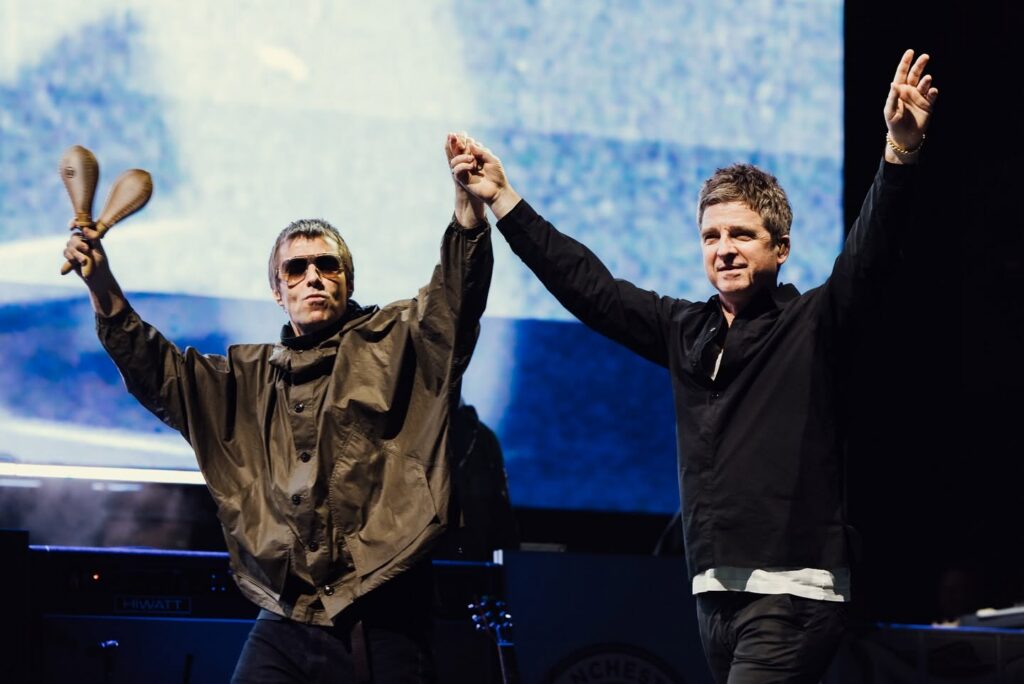
The tour finally began at Cardiff’s Principality Stadium on July 4, 2025, ending a nearly 16-year wait to see Liam and Noel on an Oasis stage together. The symbolism was impossible to miss. A pre-show montage referenced the brothers’ notoriously hostile history before declaring that “the guns have fallen silent,” and Liam and Noel walked onto the stage together before launching into “Hello.” The roughly two-hour, 23-song show concentrated overwhelmingly on the band’s classic catalog, including “Acquiesce,” “Morning Glory,” “Supersonic,” “Cigarettes & Alcohol,” “Live Forever,” “Slide Away,” “Whatever,” “Wonderwall,” “Don’t Look Back in Anger” and “Champagne Supernova.” Rather than attempting to reinvent Oasis with a radically modern production, the concerts largely depended on the extraordinary familiarity of the songs and tens of thousands of people singing them together. The touring lineup reinforced that connection to the band’s past, with Gem Archer, Paul “Bonehead” Arthurs and Andy Bell joining Liam and Noel alongside drummer Joey Waronker and additional touring musicians.
The scale of the British portion demonstrated just how enormous the reunion had become. Oasis played five concerts at Heaton Park in Manchester, transforming their hometown into the symbolic center of the comeback, with approximately 370,000 people attending the run. London was even bigger: Oasis ultimately played seven concerts at Wembley Stadium, five during July and August and another two on September 27 and 28. Edinburgh received three Murrayfield Stadium concerts, while Cardiff and Dublin hosted two each. The Manchester shows carried particular emotional weight because Oasis’s identity had always been inseparable from the city, and the reunion created what amounted to a temporary Oasis economy throughout Manchester. UK Music later reported that music-tourism spending in northwest England increased 16 percent year-over-year to approximately £1.4 billion during a year highlighted by the five Heaton Park concerts.
The phenomenon proved equally capable of crossing borders. Oasis sold out two nights at Toronto’s Rogers Stadium, two at MetLife Stadium outside New York City, two at the Rose Bowl in Pasadena and two at Mexico City’s Estadio GNP Seguros. Management later claimed demand had been so overwhelming that the band potentially could have sold six Rose Bowls and eight MetLife Stadium concerts in a single day. The tour then moved through Asia and Australia, including two Tokyo Dome performances, three nights at Melbourne’s Marvel Stadium and two at Sydney’s Accor Stadium. South America provided an appropriately feverish conclusion, with two nights at River Plate’s stadium in Buenos Aires, a Santiago concert and two final shows at São Paulo’s Estádio MorumBIS on November 22 and 23. By the time the final notes were played, Oasis had completed 41 concerts across 14 countries and five continents.
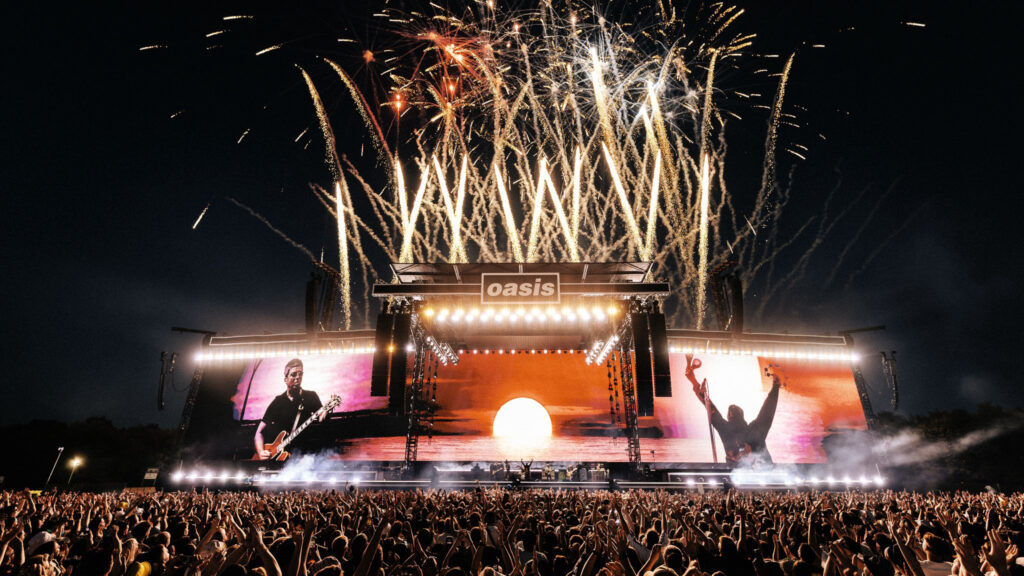
Financially, Live ’25 ranked among the largest tours in the world. Pollstar’s year-end reporting credited 36 reported/estimated dates with 2,228,471 tickets sold and $405,428,435 in box-office gross, at an average ticket price of $181.93. Those figures therefore should not be confused with the band’s profit, nor do they necessarily represent audited results for all 41 concerts. On Pollstar’s year-end chart, Oasis finished second behind Beyoncé’s Cowboy Carter Tour, which grossed approximately $407.6 million. The remarkable difference was ticket volume: Oasis’s reported 2.23 million sales substantially exceeded Beyoncé’s roughly 1.6 million despite the two tours generating similar grosses. The reunion was therefore not simply lucrative nostalgia; it immediately placed a band that had been inactive for 15 years alongside the biggest contemporary stadium acts in the world.
According to Celebrity Net Worth, both Liam Gallagher and Noel Gallagher each walked away with a reported $125 million. The brothers also split another $25 million in profit from merchandise sales, taking home $12.5 million each. The documentary deal for Oasis: Don’t Look Back in Anger reportedly added another estimated $12.5 million for each of the Gallagher brothers.
The economic effect extended far beyond ticket revenue. Around Wembley alone, Lloyds Banking Group estimated spending reached £5.1 million during Oasis’s first Wembley concert on July 25, an 88 percent increase compared with an ordinary Friday in the area. That was greater than the estimated spending surrounding Taylor Swift’s first 2024 Wembley show and Dua Lipa’s 2025 Wembley appearance, inspiring the nickname “Gallaghernomics.” Pubs and bars around Wembley experienced particularly dramatic increases in business. Hotels, restaurants, transportation companies, merchandise sellers and other businesses similarly benefited as fans traveled internationally to attend concerts. Oasis had effectively become a tourism event as well as a rock tour.
Perhaps more impressive was the comeback’s impact on pop culture. Within days of the reunion announcement, Spotify reported that global Oasis streams had risen 690 percent, while the band’s music returned to the charts and “Live Forever” eventually reached a new UK peak of No. 8. The reunion simultaneously introduced Oasis to younger listeners who had never experienced the band while it was active and gave older fans an opportunity to relive the Britpop era on an unprecedented stadium scale. The tour’s visual culture became nearly as recognizable as the music. Bucket hats, parkas, Adidas trainers, football shirts and vintage Oasis T-shirts suddenly became fashionable again. In June 2025, JD reported searches for “Oasis fashion” had increased 913 percent, while Depop recorded huge increases in searches for parkas and bucket hats. The Oasis x Adidas collection largely sold out online, pop-up stores attracted queues, and the bucket hat once again became an instantly recognizable symbol of Britpop.
Live ’25 also became something increasingly rare in an era of fragmented entertainment: a genuine shared cultural event. Social media filled with footage of stadiums singing “Don’t Look Back in Anger,” “Wonderwall” and “Champagne Supernova,” along with memes portraying Oasis concerts as a form of communal therapy. The Los Angeles Times compared the cultural position of the tour to Taylor Swift’s Eras Tour, particularly in the way it turned concert attendance into a communal experience extending far beyond the performance itself. For many fans, the emotional center of the tour was not simply hearing the songs again but seeing Liam and Noel standing together. Noel later admitted that he had underestimated the intensity of the reaction, saying the scale of the Cardiff opening overwhelmed him and praising Liam’s performance throughout the tour. The spectacle of two brothers whose hostility had helped define their mythology walking onstage together became part of the attraction itself.
A year later, the comeback’s cultural afterlife was still expanding. The tour became the subject of the feature documentary Oasis: Don’t Look Back in Anger, which premiered at the Venice Film Festival in September 2026 and chronicles the reunion, rehearsals, performances and renewed relationship between Liam and Noel. The existence of a major film devoted to the tour illustrates how quickly Live ’25 passed from a reunion into another chapter of Oasis mythology. The 41-show trek ultimately demonstrated something that had been difficult to measure during the band’s years apart: Oasis had become considerably bigger than the band that broke up in 2009. Their audience now encompassed original 1990s fans, their children and younger listeners who discovered the catalog through streaming and social media.
In that sense, the greatest achievement of Oasis Live ’25 was not its roughly $405.4 million reported gross or its more than 2.2 million reported ticket sales, impressive as those numbers were. It was the transformation of a notoriously bitter breakup into one of rock’s most successful reunion stories. For months, Oasis seemed to be everywhere again—from stadiums and streaming charts to clothing, memes, pubs, football culture and social media. Manchester became a pilgrimage site, Wembley became the setting for seven enormous celebrations, and stadiums from the Rose Bowl to River Plate were filled with audiences singing songs written three decades earlier. Rather than functioning solely as a nostalgia tour, Live ’25 demonstrated that the music Oasis created during the 1990s had become multigenerational popular culture. Sixteen years after disappearing in acrimony, Oasis returned to find that their audience had not merely waited for them—it had grown.